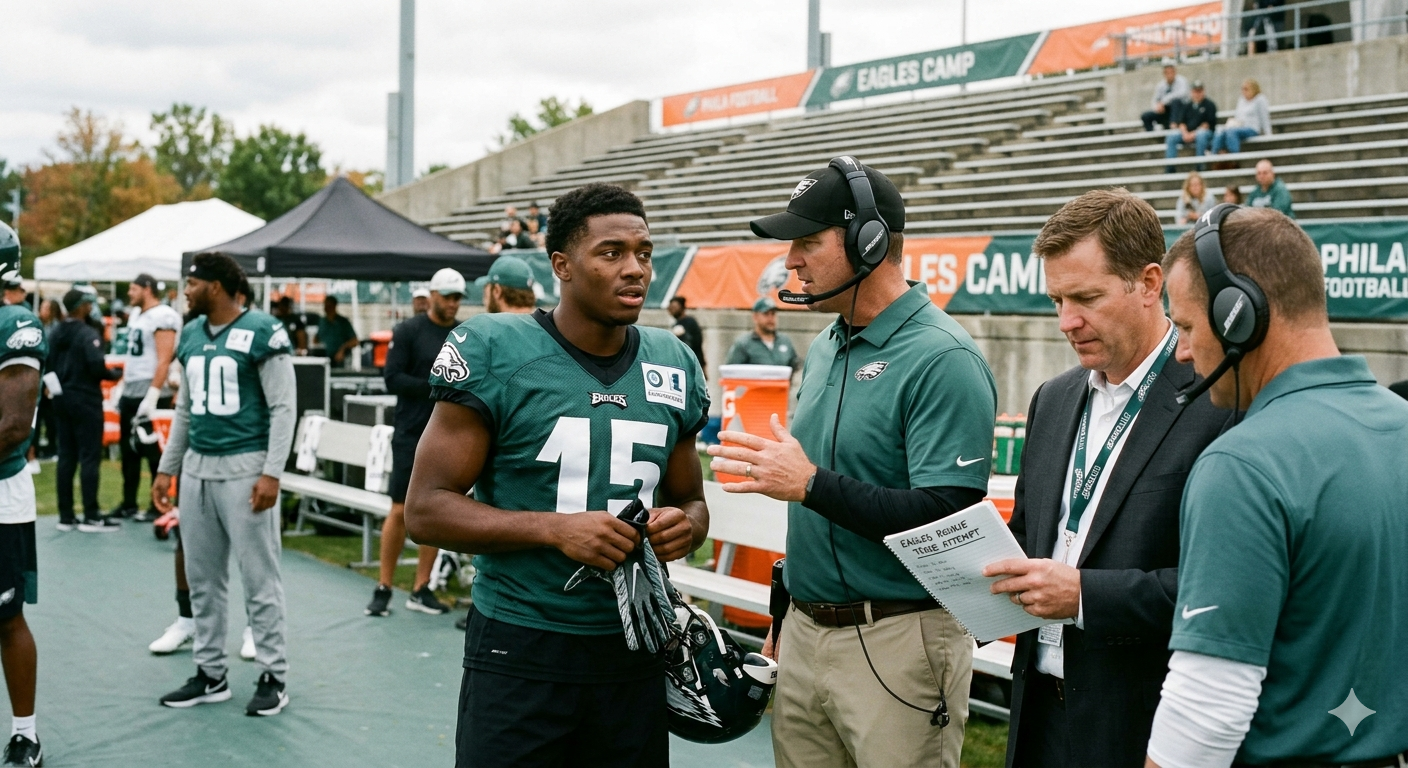
There is something electric about draft night in the NFL. The uncertainty, the drama, the phone calls that change franchises—if you are a football fan, you know exactly what I am talking about. And if you have been following the Philadelphia Eagles over the past decade, you know that General Manager Howie Roseman treats draft night like a chess match, always three moves ahead of everyone else.
I have been watching the Eagles closely since the Andy Reid era, and I can tell you that Roseman’s approach to the draft has evolved into something that resembles art more than science. The man simply does not sit still. When the 2025 NFL Draft kicked off in Green Bay, Wisconsin, Roseman was already working the phones. The result? A trade that moved the Eagles up one spot—from pick No. 32 to No. 31—and secured them a player they had been chasing all night.
That player was Jihaad Campbell, a linebacker from Alabama who had first-team All-SEC honors and 117 tackles in 2024. But this was not just about adding a talented rookie. This was about a team that just won the Super Bowl, recognizing that staying on top requires aggressive, calculated risks. Let me walk you through what happened, why it matters, and what it tells us about how championship teams think about roster construction.
The Trade That Shook Up Round One
Here is exactly what went down. The Eagles entered the draft holding the 32nd overall pick—the final selection of the first round. In most years, that is a solid spot. You get a first-round talent without the first-round pressure, plus you get that coveted fifth-year option on the rookie contract. But Roseman was not content to wait.
According to multiple reports, the Eagles had been trying to trade up earlier in the draft to get Campbell. When those efforts did not pan out, they found a willing partner in the Kansas City Chiefs, who held the 31st pick. The deal was simple but significant: Philadelphia gave up its No. 32 pick and its No. 164 pick (a fifth-rounder) to move up one spot.
Now, you might be thinking: one spot? Is that really worth a fifth-round pick? And that is a fair question. Fifth-round picks are not throwaways—they represent about 20% of your draft capital in a typical year. But here is the thing about Roseman: he does not make moves like this on a whim. When he spoke to reporters after the pick, he made it crystal clear why they did it.
“This was a really easy pick,” Roseman said. “This was a top-10 player on our board.”
That quote tells you everything you need to know. The Eagles had Campbell graded significantly higher than where he was available. In their evaluation, they saw a player who could contribute immediately, fit their defensive scheme perfectly, and provide value well beyond his draft slot. When you view it through that lens, giving up a fifth-rounder to secure a top-10 talent at pick 31 looks like a steal, not an overpay.
Why Jihaad Campbell Was Worth the Price
Let us talk about the player for a moment because understanding Campbell helps explain why the Eagles were so aggressive. Standing at 6-foot-2 and around 230 pounds, Campbell is the modern prototype for an NFL linebacker. He is fast enough to cover tight ends and running backs in space, physical enough to take on blockers at the point of attack, and smart enough to direct a defense from the middle.
During his time at Alabama, Campbell demonstrated the versatility that defensive coordinators dream of. Yes, he made 117 tackles in 2024 playing primarily as an off-ball linebacker. But he also rushed the passer and showed he could contribute to an edge rotation. That flexibility is gold in today’s NFL, where defenses need players who can do multiple things to counter spread offenses.
Now, there is the medical concern that everyone brings up. Campbell underwent left shoulder surgery to repair a torn labrum after the NFL scouting combine. For some teams, that was a red flag. For the Eagles, it was a non-issue. Roseman explicitly stated that the organization has no concerns about Campbell’s long-term health.
Having watched how the Eagles handle medical evaluations—remember, this is the same team that took a chance on Jalen Hurts’ knee and Sidney Jones’ Achilles—they do their homework. If they say they are not worried, I tend to believe them.
The local connection does not hurt either. Campbell grew up just outside of Philadelphia, so you are getting a kid who understands what it means to play in this city. Eagles fans are notoriously tough, but they love players who genuinely want to be here. Campbell fits that mold.
The Defensive Need That Made This Necessary
To really understand this trade, you have to look at what happened to the Eagles’ defense this offseason. They lost six key contributors from their Super Bowl-winning unit. Six. That is not a small number. Josh Sweat and Brandon Graham are gone from the edge. C.J. Gardner-Johnson was traded to Houston. Darius Slay signed with Pittsburgh. Milton Williams left in free agency.
That is a lot of talent walking out the door. And while the Eagles have done a good job developing young players—guys like Nolan Smith Jr. and Jalyx Hunt are ready for bigger roles—you cannot replace that much experience without adding fresh talent.
The linebacker position specifically was a concern. Nakobe Dean, who was supposed to be the future at that spot, is still recovering from a torn patellar tendon. That injury is nasty, and the return timeline is uncertain. Zack Baun played well last season, but you need depth. You need competition. You need players who can step in if Dean is not ready for Week 1.
Campbell gives them all of that. He will compete with Jeremiah Trotter Jr. for playing time opposite Baun early in the season. If Dean is not ready, Campbell could very well be starting by September. And even if Dean comes back strong, Campbell’s ability to play on the edge means he will find his way onto the field in sub-packages.
Defensive coordinator Vic Fangio has a specific vision for his defense, and it requires linebackers who can think fast and move faster. Campbell fits that profile. Fangio has a history of getting the most out of versatile defenders, and I expect Campbell to be the latest example of that.
Howie Roseman’s Draft Philosophy: Never Sit Still
I want to take a step back and talk about the bigger picture here because this trade is not an isolated incident. It is part of a pattern that has defined Roseman’s tenure as GM.
Over the past 10 years, Roseman has conducted more than 45 draft-day trades.
Let that number sink in. That is nearly five trades per draft. The man is constantly moving, constantly evaluating, constantly looking for value. Sometimes he trades up. Sometimes he trades down. Sometimes he moves around the board like he is playing three-dimensional chess.
What makes Roseman special is that he understands the rookie wage scale better than almost anyone in the league. He knows that hitting on draft picks is the only way to sustain success in a salary-capped sport. When you pay your quarterback—Jalen Hurts just got a massive extension—you need cheap, productive players around him. Rookies on their first contracts are the most valuable assets in football.
But Roseman also knows that not all draft picks are created equal. A fifth-round pick has about a 15-20% chance of becoming a meaningful contributor. A late first-round pick has closer to a 60-70% chance. When you have a player graded as a top-10 talent falling to 31, the math says you should be aggressive. The expected value of Campbell at 31 is significantly higher than the expected value of whatever player you might get at 32 plus a fifth-rounder.
This is the kind of decision-making that separates good GMs from great ones. It is easy to sit back and take the best player available. It takes confidence and conviction to move up and get your guy. Roseman has shown time and again that he is willing to make those calls.
The Rest of the Draft: Building Depth
While the Campbell trade got the headlines, it was just the beginning of the Eagles’ 2025 draft class. Roseman used the rest of his picks to address specific needs and add depth to a roster that is already one of the best in football.
In the second round, they took Andrew Mukuba, a safety from Texas who led the SEC with five interceptions in 2024.
With Gardner-Johnson gone and questions about the safety spot opposite Reed Blankenship, Mukuba provides competition and playmaking ability. He is a bit undersized at 6-foot, 185 pounds, but his ball skills are undeniable.
The Eagles continued to bolster their defensive line in the fourth round with Ty Robinson from Nebraska. Robinson had 15 tackles for loss in 2024, the most by a Nebraska player since Ndamukong Suh in 2009.
With Milton Williams gone, Robinson adds depth to a tackle rotation headlined by Jalen Carter and Jordan Davis.
They also added Mac McWilliams, a cornerback from Central Florida, in the fifth round. McWilliams ran a 4.41-second 40-yard dash at the combine and provides versatility to play both outside and in the slot.
With Darius Slay gone, the Eagles need bodies in the secondary, and McWilliams gives them options.
On offense, the Eagles finally addressed the offensive line in the fifth round with Drew Kendall, a center from Boston College. Kendall started 37 games in college and tested well at the combine.
He will likely compete for a guard spot since Cam Jurgens has center locked down, but he provides valuable depth on the interior.
They also took two tackles in the sixth round—Myles Hinton from Michigan and Cameron Williams from Texas—continuing their tradition of drafting and developing offensive linemen. Jeff Stoutland, the Eagles’ offensive line coach, is widely considered the best in the business, and these developmental prospects will get every chance to succeed under his tutelage.
Finally, the Eagles added quarterback Kyle McCord from Syracuse in the sixth round. McCord led the FBS in passing yards last season with 4,779 yards and set the ACC single-season record.
With Kenny Pickett traded to Cleveland and Tanner McKee dealing with a finger injury, McCord provides insurance and competition in the quarterback room.
Lessons from Past Trade-Ups
I think it is worth putting this trade in historical context because the Eagles have a mixed history when it comes to trading up in the draft. Some moves have worked out brilliantly. Others have been disasters.
The most famous example is the Carson Wentz trade in 2016. The Eagles moved up from No. 15 to No. 2, giving up a haul of picks to select the North Dakota State quarterback. Wentz was an MVP candidate in 2017 before injuries derailed his career. While he eventually flamed out, that trade led to a Super Bowl championship, so it is hard to call it a failure.
In 2019, the Eagles traded up from No. 25 to No. 22 to select Andre Dillard, an offensive tackle from Washington State. Dillard never panned out and was eventually traded to Tennessee. That one did not work out as planned.
But then you have examples like Jalen Hurts in 2020, where the Eagles stayed put at No. 53 and got their quarterback of the future. Sometimes patience pays off. Sometimes aggression is required.
The Campbell trade feels different from the Wentz and Dillard moves because the cost was so much lower. Moving up one spot for a fifth-round pick is not mortgaging your future. It is a calculated risk with limited downside. Even if Campbell does not become a star, the opportunity cost was minimal.
What Fans Are Saying
I have been scrolling through Eagles Twitter (or X, whatever we are calling it now) since the draft, and the reaction has been overwhelmingly positive. Fans love aggressive moves, especially when they come from a front office that has earned their trust. Roseman has built up so much goodwill with the Super Bowl win that fans are willing to give him the benefit of the doubt on just about any move.
The local media have been similarly supportive. ESPN’s Tim McManus noted that the Eagles have had success drawing from top programs like Alabama and Georgia in recent drafts, and Campbell continues that trend.
The Philadelphia Inquirer praised the move as “classic Roseman”—aggressive, smart, and focused on value.
Analysts have given the Eagles high marks for their draft class. Most grade the Campbell pick as an A or A-minus, recognizing both the talent of the player and the wisdom of the trade. When you can get a top-10 talent at pick 31, you have done your job as a GM.
Looking Ahead: What This Means for 2025
So, where does this leave the Eagles as they head into the 2025 season? In a pretty good spot, honestly. They addressed their biggest defensive needs through the draft, added depth on both sides of the ball, and maintained their core of star players.
Campbell will have every opportunity to earn significant playing time as a rookie. Whether he starts immediately or works his way into the rotation, he is going to be on the field. His development will be one of the most interesting storylines to watch during training camp and the preseason.
The bigger picture is that the Eagles are trying to do something incredibly difficult: repeat as Super Bowl champions. History is not on their side. Only a handful of teams have ever won back-to-back titles, and the last one to do it was the 2004-2005 Patriots. The odds are against them, but moves like this give them a fighting chance.
Roseman understands that standing pat is not an option when you are the defending champs. Every other team is gunning for you. Every other team is trying to get better. If you are not aggressive, if you are not looking for every possible advantage, you are going to get passed by.
The Campbell trade is a perfect example of that mindset. It was not a huge move in terms of draft capital, but it was a huge move in terms of message. The Eagles are not content to rest on their laurels. They are going to keep pushing, keep improving, and keep trying to find edges wherever they can.
That is what makes this franchise special right now. They have the best quarterback in football. They have one of the best front offices in football. And they have a culture that demands excellence. The rookie trade attempt for Jihaad Campbell is just the latest chapter in that story.
Conclusion
The Eagles’ decision to trade up for Jihaad Campbell in the 2025 NFL Draft represents everything that makes Howie Roseman one of the best general managers in football. It was aggressive without being reckless, calculated without being conservative, and focused on value above all else. By moving up one spot to secure a player they had graded as a top-10 talent, the Eagles addressed a critical defensive need while maintaining their long-term financial flexibility. As they look to defend their Super Bowl title, moves like this will be the difference between a good team and a great one.
Frequently Asked Questions (FAQ)
Q1: Who did the Eagles trade up for in the 2025 NFL Draft? A: The Eagles traded up one spot from pick No. 32 to No. 31 to select Jihaad Campbell, a linebacker from Alabama.
Q2: What did the Eagles give up to trade up for Jihaad Campbell? A: The Eagles gave up their original first-round pick (No. 32) and their fifth-round pick (No. 164) to the Kansas City Chiefs in exchange for pick No. 31.
Q3: Why did the Eagles trade up just one spot? A: According to GM Howie Roseman, Campbell was a “top-10 player on our board,” and they wanted to ensure they secured him before another team could. They had actually tried to trade up earlier in the draft as well.
Q4: Is Jihaad Campbell healthy enough to play in 2025? A: Yes. Campbell underwent left shoulder surgery to repair a torn labrum after the combine, but Roseman confirmed the Eagles have no concerns about his long-term health.
Q5: How many draft-day trades has Howie Roseman made? A: Over the past ten years, Roseman has conducted over 45 draft-day trades, making him one of the most active traders among NFL general managers.
Q6: What other rookies did the Eagles draft in 2025? A: The Eagles selected Andrew Mukuba (S, Texas) in Round 2, Ty Robinson (DT, Nebraska) in Round 4, Mac McWilliams (CB, UCF) and Smael Mondon Jr. (LB, Georgia) in Round 5, Drew Kendall (C, Boston College), Kyle McCord (QB, Syracuse), Myles Hinton (OT, Michigan), Cameron Williams (T, Texas), and Antwaun Powell-Ryland (Edge, Virginia Tech) in Round 6.
Q7: Will Jihaad Campbell start as a rookie? A: It depends on Nakobe Dean’s recovery from a torn patellar tendon. If Dean is not ready for Week 1, Campbell could compete with Jeremiah Trotter Jr. for a starting spot opposite Zack Baun.
Q8: What is the fifth-year option in rookie contracts? A: The fifth-year option is a team-friendly contract extension that first-round picks carry, allowing teams to keep players for an additional year at a predetermined salary before they hit free agency.
Q9: How does the rookie wage scale help the Eagles? A: The rookie wage scale keeps first-round pick salaries relatively low and fixed, allowing teams to get high-quality talent at affordable prices, which is crucial when paying a franchise quarterback like Jalen Hurts.
Q10: What defensive scheme does Vic Fangio run, and how does Campbell fit? A: Fangio runs a scheme that requires versatile linebackers who can cover, rush the passer, and play the run. Campbell’s ability to play both off-ball linebacker and on the edge makes him an ideal fit for this system.
About the Author